The federal technology landscape has never moved faster, and the margin for error has never been smaller. While much of the industry spent 2025 reacting to sweeping change, GDIT was executing — delivering on a technically differentiated strategy it had been building for years.
Now, with real momentum and a sharpened strategy called VIA – short for Vision, Innovation, and Acceleration – the company is advancing into what its president calls the most transformational moment for technology of our generation.
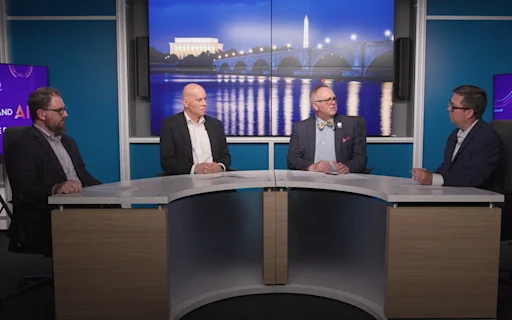
Roger Cressey, Partner at Mountain Wave Ventures, sat down with Amy Gilliland, GDIT President, to understand what that strategy looks like in practice, and what it means for the missions that matter most.
Q: 2025 was an unprecedented year of change, yet GDIT performed exceptionally well. What drove that success?
It was certainly an adventure of a year, but we had an established strategy in place, and we went after it. We weren’t reacting — we had invested over a long time in our technology as well as our workforce, and we were ready to bring those solutions to bear.
On the one hand, we put our heads down and focused on our technically differentiated strategy. But just as importantly, our customers needed us. It was a stressful time — programs were being cut, positions were changing. It would have been easy to push back against those dynamics, but instead we recognized that our customers needed our help. We showed them how to meet new technology requirements from the administration.
And with an administration embracing commercial technology in new ways, it became a fabulous opportunity to showcase what we had been working on for the past couple of years.
Q: It's really a great success story because of the strategy you had put in place, you executed on it in a very turbulent environment, and you were successful. You recently announced the Vision, Innovation, and Acceleration (VIA) business strategy. What does it represent, and why now?
It is the natural next step in our technology differentiation strategy. Why VIA now? We have a front-row seat to some of the most spectacular technology evolution of our generation. As a technology provider, we cannot sit still — what served the mission yesterday is not what serves the mission today. I think we find ourselves in a completely new era.
The “V” is for Vision. This is about how we stay focused on the mission by leveraging all the resources across GDIT — and across General Dynamics more broadly — in places where we may have gone to market individually, but weren’t fully harnessing everything together.
Innovation is the second pillar. We are a technology business. We have to continue to innovate, and to do that, we have to invest. We’ve been investing over the last couple of years — including in 10 Digital Accelerators focused on our customers’ pipeline and on what matters most to them: AI, cyber, and software development. But it was time to take the next step and increase our investments in technology solutions. Those solutions are in areas that are important to our customers' missions, like full spectrum cyber and aerial defense. Expanding our technology solutions is a new and important part of what we’re focused on.
And then, finally, Acceleration. I view speed — and we see this everywhere — as the most important thing we do. We’ve doubled down on our partnerships because our commercial partners are making incredible investments in technology. As a systems integrator, it’s our responsibility to bring those technologies to bear for our customers and accelerate their missions.
We also have a tremendous workforce — our greatest asset at GDIT. We continue to look at how we can build the technology workforce of the future, and that means that we need to continue to invest in our people.
VIA is about bringing all of this together. It’s really exciting, because the strategy has worked — and now we’re adding additional pieces to it.
“We have a front row seat to some of the most spectacular technology evolution in our generation. As a technology provider, we cannot sit still and what served the mission yesterday is not what serves the mission today. I think we find ourselves in a totally new era.”
Q: What are your mission campaigns? Tell me more about them.
First of all, let me make clear that mission campaigns are places we have been in for a long time. The campaigns are deliberate strategies that allow us to leverage all the resources across GDIT, and across General Dynamics for the mission.
First, the battlespace of the future. What's so interesting about battlespace of the future is that you might immediately think of far-off locations and Golden Dome. That's absolutely part of it. But battlespace of the future is also on our home turf. It includes our borders, our energy infrastructure, and our ports.
The battlespace of the future campaign helps us to think more holistically about the solutions that we build. For instance, we built a tool called DOGMA for aerial defense. It incorporates AI to track all kinds of moving targets — like drones — using radar and other advanced technologies. You instantly might think about drones and the asymmetric threats we're seeing in Ukraine, Iran, and elsewhere. But there are other applications such as protecting critical infrastructure or the border.
The second campaign is focused on border security. To help protect the border, we’ve developed several solutions, including autonomous border towers that use AI to detect and track threats in real time.
And finally, we have our smart government campaign. The government wants to be more efficient, so we’re deploying AI at scale to save time, write code, strengthen cybersecurity, or enhance citizen experience with AI agents.
In any event, I am really excited about these mission campaigns. There's a lot of energy behind them and I'm seeing the business come together in new ways.
Q: You’ve also increased GDIT’s investment in technology solutions. What does that look like?
We have been investing in Digital Accelerators and solutions since 2022. We are now doubling down and investing even further.
Let me give you an example. The Government Accountability Office recently released a report that said we have $250 to $500 billion of fraud in the government system. It's really unfortunate, and as taxpayers, we don't want that — it drives up costs for all of us.
We invested in our AI software factory, AILO, which we then deployed at the Centers for Medicare and Medicaid to help identify fraud in their systems. As a result, AILO has helped save the government billions of dollars through the identification of fraudulent healthcare claims.
Another example, we invested in a zero trust stack and we are deploying that solution for the Air Force. One million users across 187 bases worldwide. It is a totally flexible stack, so this works for the Air Force, but we can also tailor that for a lot of different customers.
We have really leaned into investing in solutions that we know our customers need and delivering them to the betterment of the mission. These are real-world examples that are making a real-world difference.
Q: The administration has been very clear about wanting to get commercial technology into government faster, in ways that it has never done before. Partnerships are a big part of your strategy. How is GDIT evolving in that area?
Let me start by saying it’s great to be a systems integrator, because we can serve as an independent arbiter for the government. We don't have a professed interest in one technology over another. It is really about taking what we know about mission requirements and customer needs, and pairing them with emerging or established technology solutions. Part of this work is identifying the technologies that are out there, and the other part of it is bringing them to the mission — and you need to be very thoughtful and deliberate about that.
On the emerging technology side, when we look at our pipeline, a third of our pipeline involves what I would consider emerging technology.
On the commercial side – with more established, larger commercial companies – we are taking a bit of a different pivot. We still have a lot of partners, but we are doubling down with some of them through new strategic collaboration agreements. We actually have dozens of prototypes in solutioning right now with our commercial partners.
As an example, last year, there was an exercise called Mobility Guardian with Google. We co-developed Cloud-in-a-Box and tested it in Guam. The concept of Cloud-in-a-Box was to bring capabilities to disconnected warfighters – cloud, zero trust at the edge, and software at the edge. It was a huge success.
And we were able to use it in ways during that exercise that we didn't even understand before.
Q: The strategy also emphasizes business execution. What does that mean for GDIT and its workforce?
We’ve established a dedicated business execution office to accomplish a couple of things. First, it focuses on maintaining strong program execution. Through that lens, we can look at any challenging programs. We can look at new programs. We can look at large programs. We can really make sure that we are delivering everything that we have promised — and more — to our customers.
We also established a corporate development office to evaluate our capabilities, align them with our pipelines and partnerships, and direct our focus toward upcoming bids and long term technological priorities.
I'm really excited about what this team is doing, because our customers are looking to us not just to solve today's problems, but to really understand what capabilities we need in the future.
And finally, we're looking at our centers of excellence around cyber, AI, and software development. How can we deepen those to bring even more technology to the mission? We've seen incredible advancements in the world of large language models — most recently with Anthropic Mythos — and the impact it's going to have on cybersecurity. This space is moving so fast, and it’s why we have to continue to evolve. This is why agility and speed are so important.
Q: GDIT is growing and investing in new capabilities. How do you make sure the workforce is ready for what’s ahead?
I recognized early on that AI would reshape how we deliver for our federal government customers. And I was candid with myself and with my team: employees who don't develop AI expertise risk being left behind. As a company with a soul, I made it my personal priority to make sure we gave employees at all levels every opportunity to embrace AI and become industry-leading AI experts.
And it worked. We built an AI training program and put our entire workforce — 26,000 employees — through it. Five thousand employees have achieved our highest level of AI certification. We have enterprise AI tools implemented across the company, helping teams work faster and smarter.
I'm proud of where our workforce stands today and the progress we’ve made bringing AI into our business. But I also know we can't stand still. In this work, standing still is falling behind. I’ll continue investing to build AI expertise into our workforce, because our people are always our best investment.
Editors note: This Q&A has been edited from the video for length and context.